Women's History Tour
This self-guided Women’s History Tour invites you to experience Macomb through sites honoring the women who shaped both their community and the nation. Through these stops, you’ll discover pioneering female inventors, activists, medical innovators, artists, scholars, and political leaders whose work advanced social reform, public health, creativity, and civic life — leaving impacts that reached far beyond Macomb and McDonough County.
Created in recognition of Women’s History Month in March, the tour reveals how local female leadership helped drive national progress. As America approaches its 250th anniversary, these stories offer a powerful reminder that the American story was not built by a few famous names alone, but by determined individuals and notable females in communities like Macomb whose ideas, advocacy, and perseverance changed everyday life across the country.
Walk at your own pace, pause where history happened, and see how small-town places connect to the larger story of America.
1. "Facing the Storm" Memorial
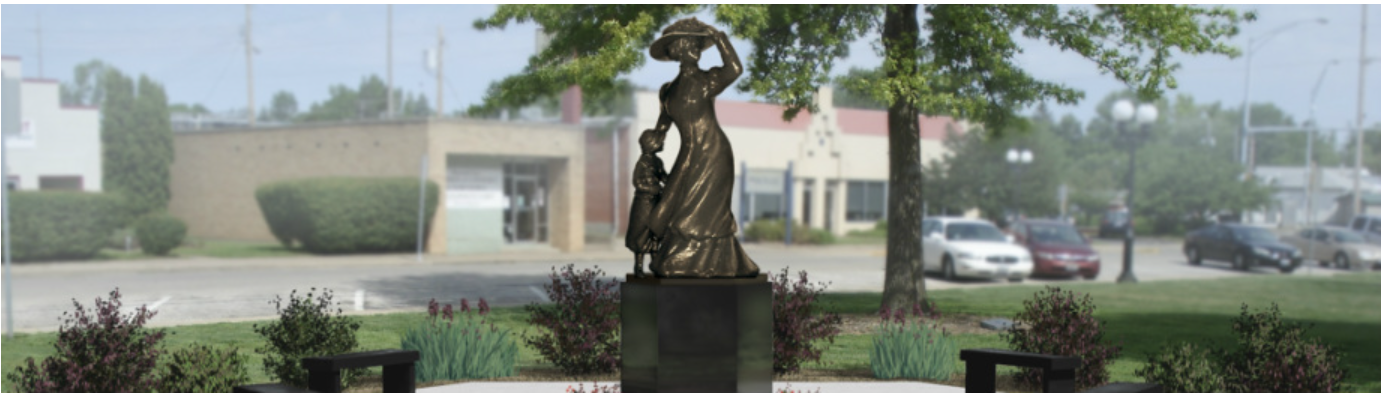
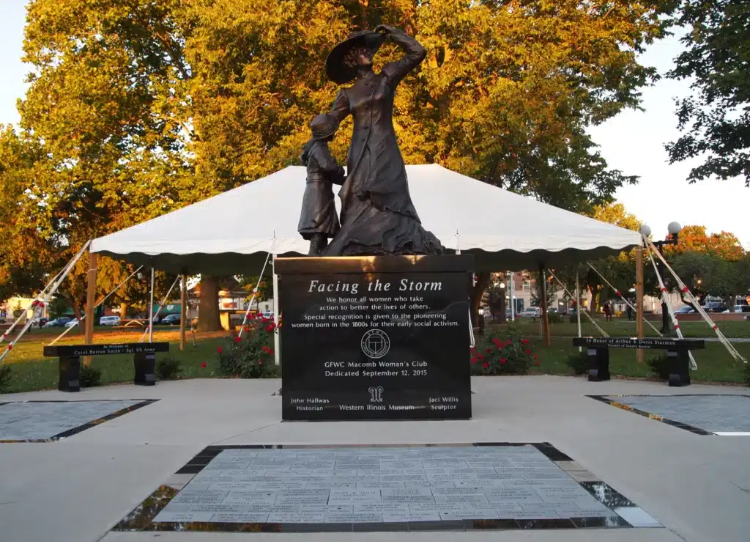
Chandler Park in downtown Macomb contains numerous statues many honoring deserving citizens including a memorial dedicated to the pioneering women of social activism in McDonough County.
Dedicated in 2015, “Facing the Storm” created by the Women’s Memorial Committee which is part of the GFWC Macomb Women’s Club, which worked on the project with assistance from the Western Illinois Museum.
The statue depicts a woman with a girl who is holding a cat. They’re dressed in clothing from the early 1900s, which was a time when women fought for and gained more rights. The bronze statue was created by Peoria-based artist Jaci Willis.
The statue memorializes the contributions of eight women with brief biographies explaining their work:
Josie Westfall, who raised money to create, expand, and operate the McDonough County Orphanage, serving as matron for 30 years, ultimately caring for some 500 children.
Dr. Ruth Tunnicliff, a published medical researcher on diseases like scarlet fever, diphtheria, and meningitis, discovered the cause of measles and created the first serum for its prevention.
Sadie “Mother” Moon, who continually reached out to provide food for the homeless, helped mothers care for their sick children, wrote regularly to local servicemen, and became an icon of neighborly concern.
Dr. Elizabeth Miner, the county’s first female physician, treated impoverished patients, promoted safe childbirth practices, and became a leader in the Illinois Medical Society.
Rose Jolly, who organized and led the county’s first social organization, the McDonough County Humane Society, devoted to the protection of children and animals.
Rebecca Everly, who established a trust to build the county’s first retirement facility for the elderly with funds from the trust helping pay expenses. Funds were also provided to acquire land for Everly Park.
Lida Crabb, who used her newspaper column, “A Day at a Time,” to promote sympathetic appreciation for others and to foster a sense of belonging while also supporting a variety of community causes.
Clara Bayliss, who crusaded for improved parenting and better home lives for children through writings, talks, and organizational work, and raised funds for the county orphanage.

2. Macombopoly: The World’s Largest Monopoly Game
Macombopoly transforms Macomb’s Historic Courthouse Square into a life-size, Monopoly-inspired game board that celebrates both the classic game and its roots in Macomb. Designed in honor of local resident Elizabeth “Lizzie” Magie-Phillips — creator of The Landlord’s Game, which later became Monopoly — the attraction brings her early 1904 board design to life right where its history began.
Players use a state-of-the-art eATLAS mobile app to walk the giant board around the Square, which mirrors Magie’s original layout, even down to the corner where she placed the Jail square, aligning with the historic location of the Macomb Jail. Surrounding the Courthouse lawn are oversized game pieces, including giant spinning dice, Abraham Lincoln’s iconic stovepipe hat, a hybrid Monopoly/Landlord’s Game board, and a life-size sculpture of Lizzie herself, all created by artist Gabe Stevens.
Free and open to the public 24/7, year-round, Macombopoly offers an interactive way to explore downtown Macomb while honoring a groundbreaking local inventor. Download the free app on eATLAS and start the adventure.
3. Elizabeth "Lizzie" Magie Sculpture
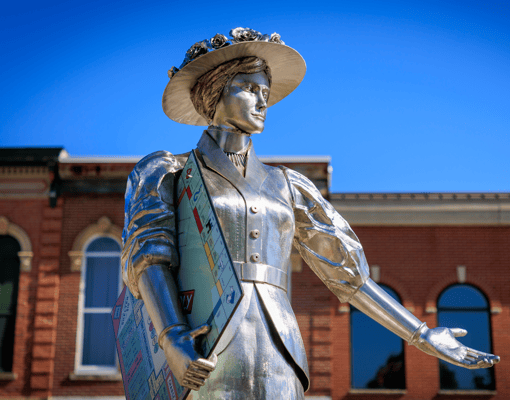
Located on the Historic Macomb Courthouse Square, this stainless steel sculpture honors Elizabeth "Lizzie" Magie, the Macomb-born visionary who invented the game that was the precursor to Monopoly. Born in 1866 to an abolitionist father who traveled with Abraham Lincoln, Magie was a pioneering feminist, actress, and poet. She designed The Landlord’s Game in 1903 to educate the public about economic inequality, featuring the now-iconic "Go to Jail" instruction and a circular board inspired by the very streets of downtown Macomb.
Though her creation was later appropriated and sold to Parker Brothers by Charles Darrow, this monument reclaims her legacy as the true mind behind the world's most famous board game. Standing as one of four "Macombopoly" statues, it serves as a permanent tribute to her intellectual grit and her radical mission to use play as a tool for social change.
4. Monopoly and Landlord's Game Sculpture
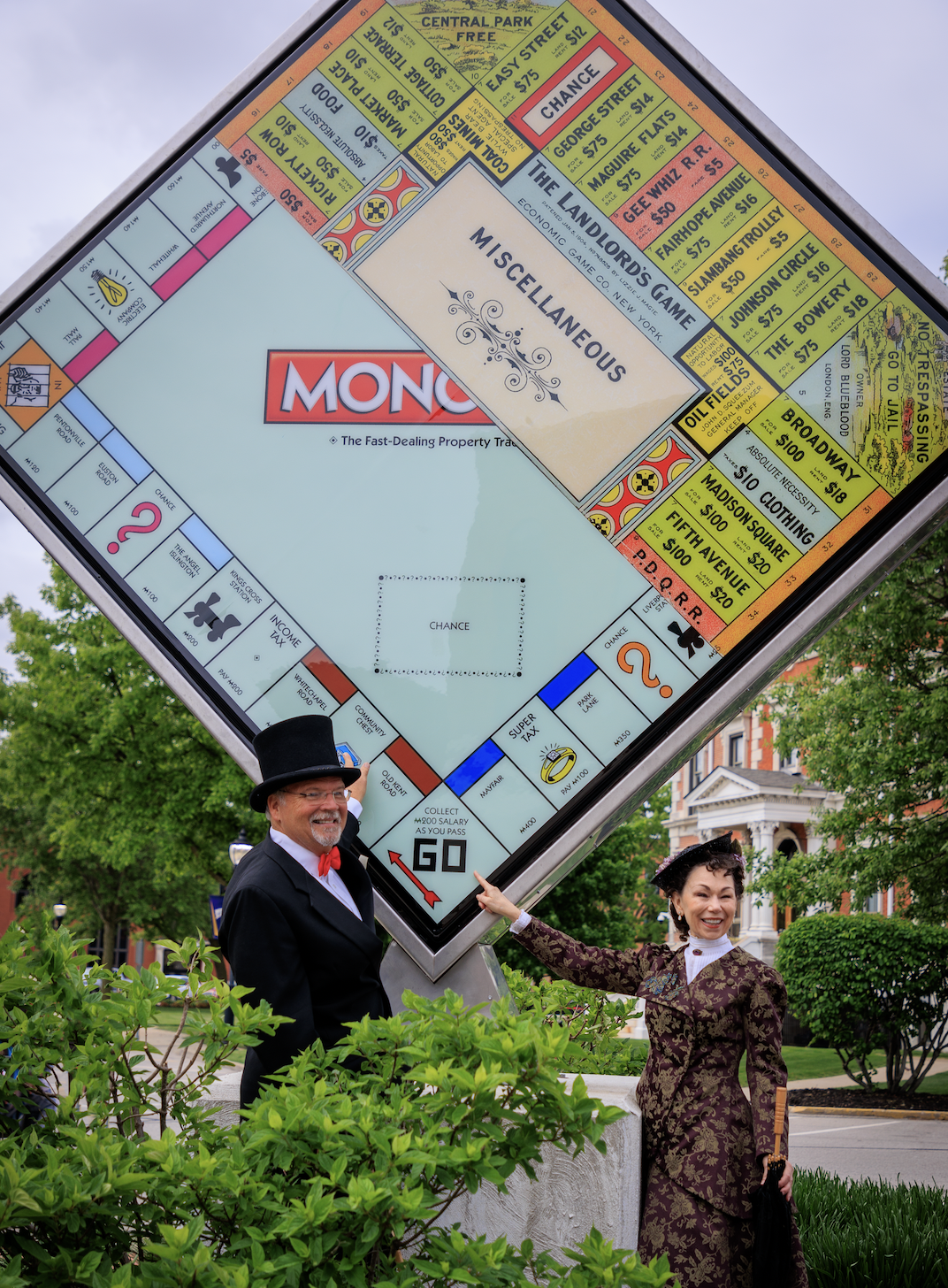
The second of four Monopoly-themed statues around the square is the Landlord's Game and Monopoly sculpture – an ode to Lizzie's original invention.
“The Landlord’s Game” which eventually became known as the game of “Monopoly”, was invented by Lizzie in 1903. She filed a legal claim for the game which, three decades later, became what we know as the Monopoly board game today.
The plat of the original board game and Monopoly is surprisingly similar to that of Macomb’s Downtown Square. In one corner were the Poor House and the public park and across the board was the jail.
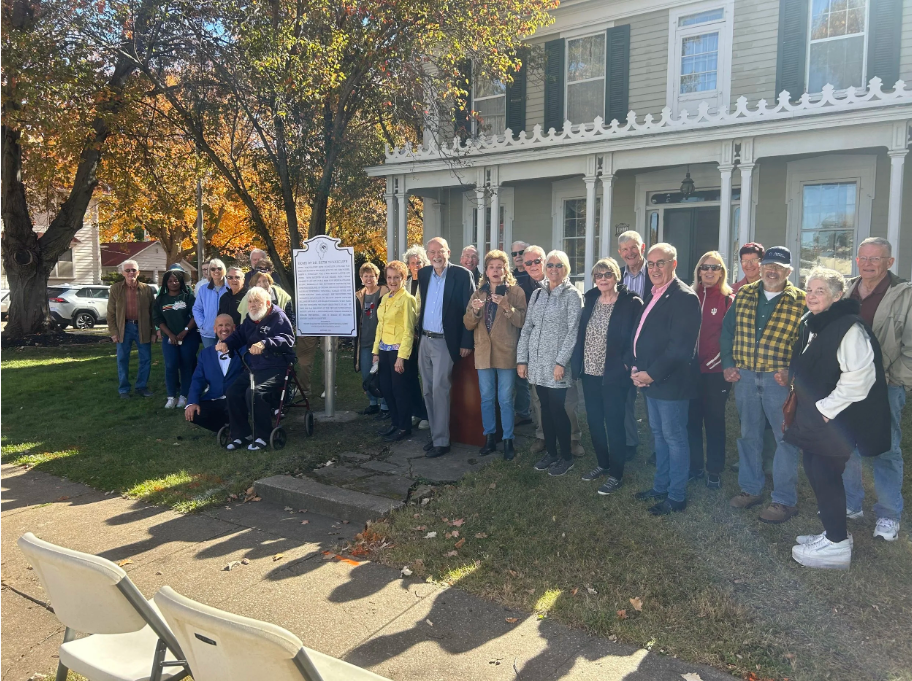
5. Home of Immunologist, Dr. Ruth Tunnicliff
This marker outside Dr. Ruth Tunnicliff's home in Macomb recognizes her as groundbreaking female leader in disease prevention. Ruth May Tunnicliff was the youngest of three remarkable sisters born in Macomb. Like her sisters, Ruth was tutored at their home, probably by her mother, and then attended Vassar College and received her A.B. degree with Phi Beta Kappa honors at the age of 19, as did her sisters.
Ruth took pre-med courses at the University of Chicago in the late 1890’s, followed by medical study at the Women’s Medical College at Northwestern University and then Rush Medical College. She received her M.D. from Rush in 1903 in the first class to graduate women (nine women and 250 men).
Dr. Tunnicliff did pioneering research on various types of streptococci. Her major work included the discovery of the diplococcus present in the secretions (eyes, nose, mouth) of measles patients in 1917. Tunnicliff produced measles in animals and then worked out a serum. She was the first to develop an inoculation to prevent this devastating yet common disease, which in the early 20th century attacked some three to four million Americans every year. Tunnicliff’s serum, if given within 1-2 days after exposure, could successfully prevent measles.
Her achievements were remarkable, but she always struggled against gender bias. Despite being a distinguished research bacteriologist at the renowned McCormick Institute, she was never accepted as a teaching faculty member because of her gender. This marker, recognizing Ruth Tunnicliff, whose research on measles saved countless lives around the globe, reminds us of the need to preserve the past of our community, and, in a purpose-driven way, to pass it on to future generations.
Dr. Ruth Tunnicliff is interned in Macomb’s Oakwood Cemetery.
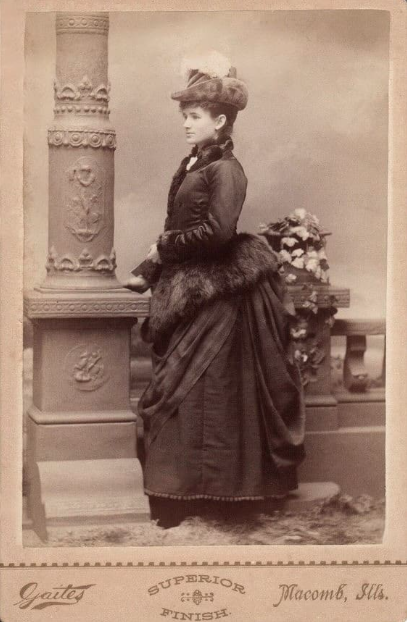
6. Laura B. Gates' Photography Studio
Laura B. Gaites was born in Macomb in 1861. Twenty years later she married H. William Gaites, who soon opened a photography studio in the 200 block of North Randolph Street. She worked with him as the first female photographer in the area, and at that time glossy “cabinet card” photographs were popular. By the 1880s, children were frequently photographed, an indication of the growing attention they were beginning to receive in American culture.
The Gaites studio had several elaborate photographic settings, including one for graduation pictures. Partly for that reason, the Gaites studio was the most successful photography business of that era, and Laura Gaites became a well-known photographer. When her husband died in 1917, she continued in the busi-ness. By the time she died in 1952, she had been a photographer for seventy-one years and, just of children alone she had taken some 35,000 images.
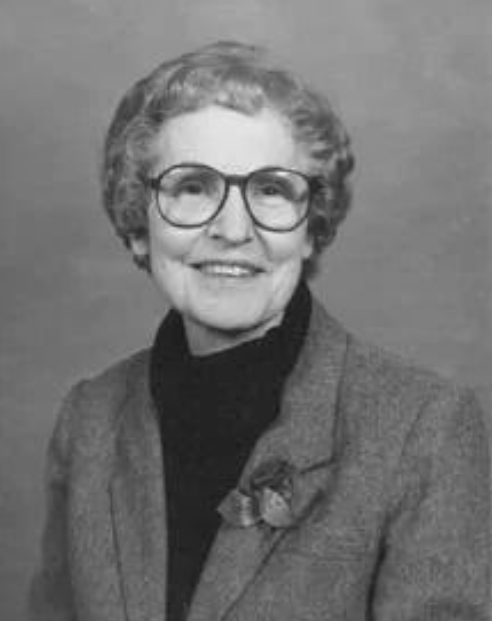
7. Dr. Lillian Snyder's Baxter/Snyder Center for Icarian Studies at WIU
Dr. Lillian Snyder was a founding member of the National Icarian Heritage Society, a member and past president of the Nauvoo Historical Society, and a member of the Illinois State Historical Society, Institute of Icarian Investigations, and the Communal Studies Association. Her love and devotion to Icaria, the nineteenth century French utopiain experiment that settled and thrived in Nauvoo from 1849-1860, provided her with a lifelong mission to preserve the society’s heritage.
A descendant of Icarian communalists, she was a driving force in the founding and developing of the Baxter/Snyder Center for Icarian Studies at Western Illinois University in Macomb, IL, and in August 2004, supported its preservation through a gift for the Endowed Professor of Icarian and Regional Studies at WIU Archives and Special Collections. Dr. Snyder also bequeathed properties in Nauvoo to the Illinois State Historical Society to perpetuate the Icarian mission in the Nauvoo community. The Lillian Snyder Icarian Living History Foundation was founded in her honor.

8. Mary Matalin, Political Consultant from Macomb and WIU
Mary Joe Matalin is an American political consultant well known for her work with the Republican Party. A graduate of Western Illinois University in Macomb, she has served under President Ronald Reagan, was campaign director for George H. W. Bush, was an assistant to President George W. Bush, and counselor to Vice President Dick Cheney until 2003. Matalin has been chief editor of Threshold Editions, a conservative publishing imprint at Simon & Schuster, since March 2005. She is married to Democratic political consultant James Carville.
Matalin was a host of CNN‘s Crossfire political debate show, and in 1993, she co-hosted Equal Time, which aired on the CNBC business television channel. Matalin was also the host of her own talk radio show in the 1990s, The Mary Matalin Show, which was carried on the CBS Radio Network. She is currently on the nationally syndicated radio program Both Sides Now w/ Huffington & Matalin, hosted by Mark J. Green and aired weekends on 120 stations. She also appears in the award-winning documentary film Boogie Man: The Lee Atwater Story and also played herself, opposite her husband, James Carville, John Slattery, and Mary McCormack in the short lived HBO series K Street.